
20Oct2025
-
20Oct2025
Beyond the Lab: Revolutionizing Human Virus Identification and Reconstruction for Better Treatment
Viruses play a crucial role in many conditions, from rare diseases and syndromes to certain cancers. Yet, most treatments focus on managing the consequences of these diseases, rather than addressing the root cause – often undetected viral infections. The tide is turning, and leading medical centers are now focusing on the viruses that reside within the human body.
Accurately identifying these viruses is key to providing the right diagnosis and treatment, guiding public health strategies, and developing vaccines and antiviral therapies. It also helps reduce unnecessary antibiotic use, combating antimicrobial resistance.
🔬 The Challenge
Currently, over 20 reproducible pipelines exist for identifying and reconstructing human viruses from sequencing data. But choosing the best pipeline—based on factors like virus type, sequencing data quality, and coverage depth—is a critical challenge that directly affects diagnostic accuracy and treatment success.
🛠️ Our Solution
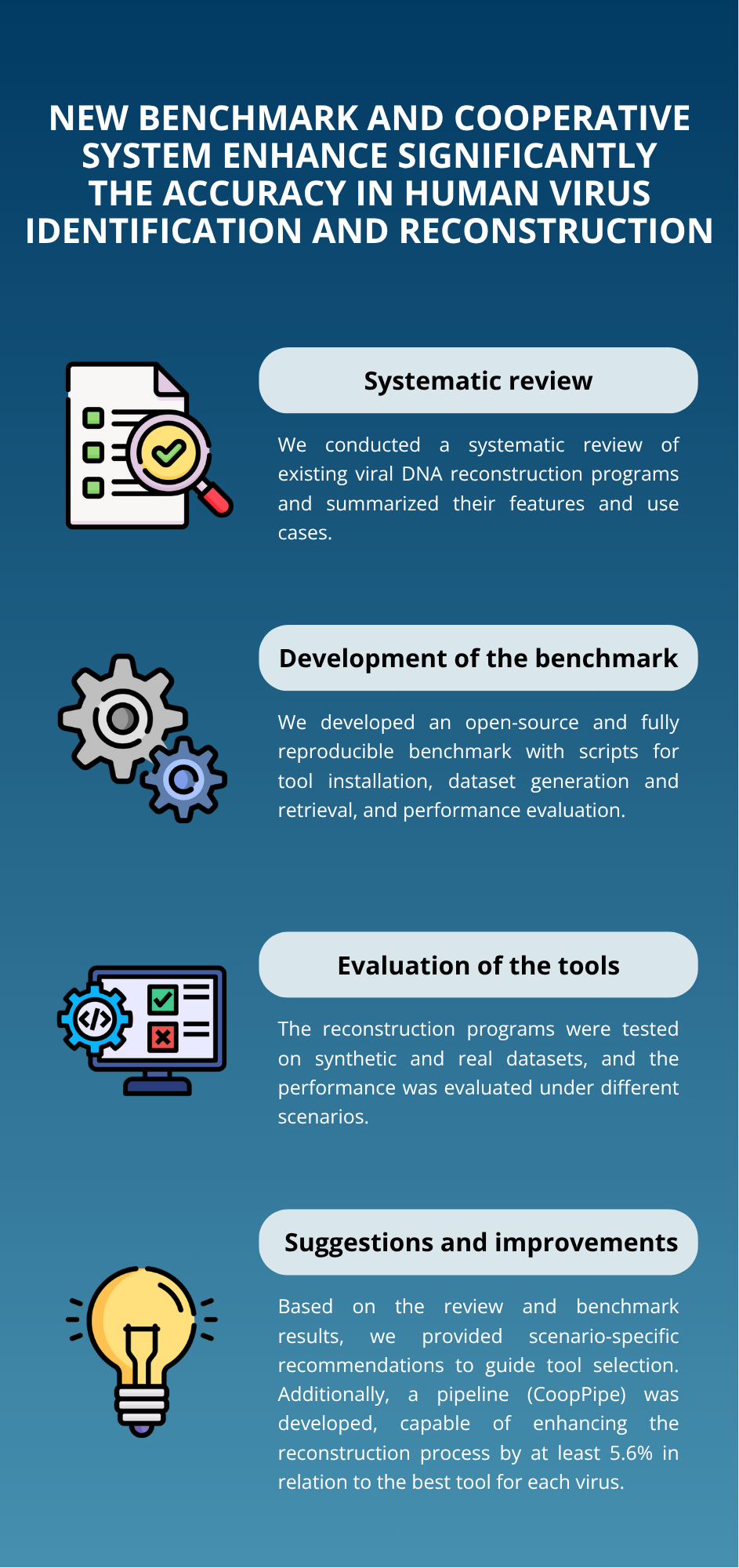
We developed HVRS, a benchmark pipeline to compare different tools under a variety of conditions (data depth, contamination, and more). Our findings offer clear recommendations on the best tools for different viral reconstruction scenarios, ensuring more accurate results for researchers.
🚀 A Step Further: CoopPipe
We built CoopPipe, a system that combines multiple pipelines, improving virus identification and reconstruction accuracy by at least 5.6% compared to the best individual tool for each virus.
🔗 Access the Tools
The HVRS and CoopPipe implementations are available for free:
This innovation not only enhances clinical virology but also speeds up diagnosis, improves treatment precision, and ultimately contributes to safer, more effective therapeutic decisions.
#VirusIdentification #Genomics #Virology #ResearchInnovation #PublicHealth #MedicalTechnology #PrecisionMedicine #ClinicalVirology #AntimicrobialResistance #HealthTech
Authored by: Maria J. P. Sousa
In collaboration with: Lari Pyöriä , Mari Toppinen , Klaus Hedman, Antti Sajantila, Maria F. Perdomo, Diogo Pratas
Supported by: FCT, IEETA/UA
Share in: