19Jan2026
-
19Jan2026
Beyond the Lab: Genomic Data Infrastructure in Practice
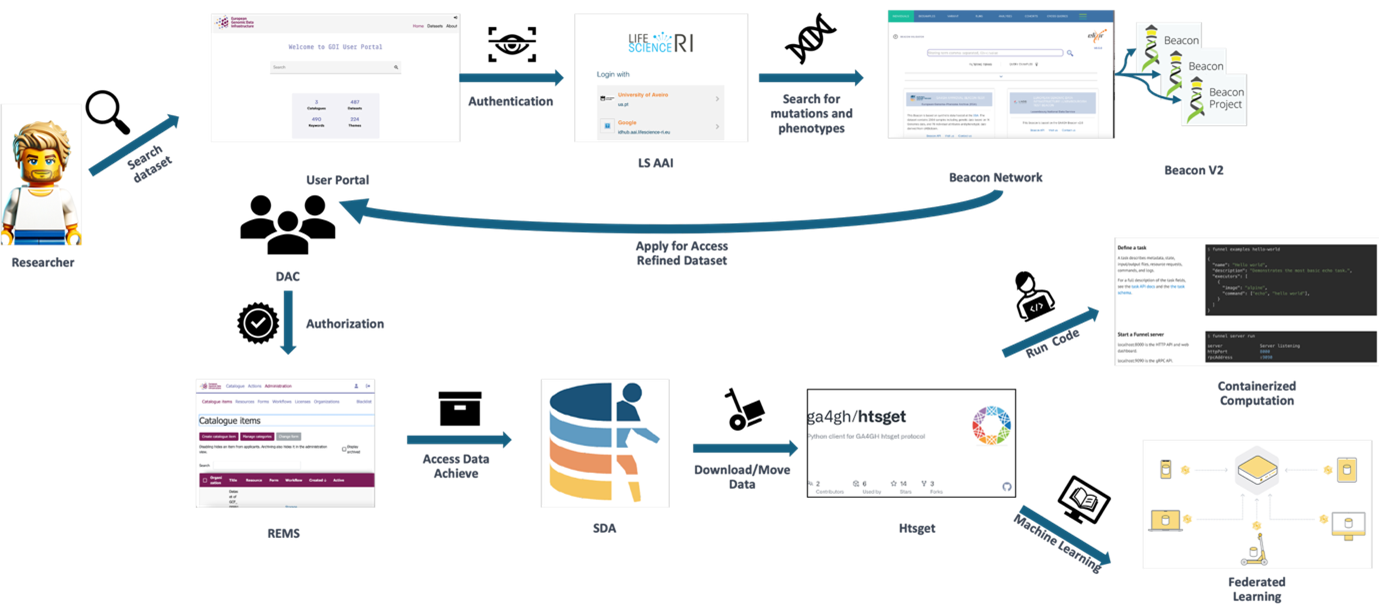
Genomic research fundamentally requires three components. Researchers must be able to find relevant data, obtain lawful and ethical access to it, and perform computations close to where the data resides. The European Genomic Data Infrastructure (GDI) addresses these needs by connecting national nodes, allowing researchers to locate datasets easily, request secure access, and run analyses efficiently without unnecessarily transferring sensitive information.
In Portugal, the national node unites the efforts of Universidade de Aveiro (IEETA), IST, INSA, and BioData.pt. Our collaborative team focuses on transforming open standards into practical services that researchers actively use. These include efficient discovery mechanisms, secure access management, encrypted storage solutions, selective data streaming, and execution of analyses within secure containers.
Key highlights
- Discovery – Beacon v2 and Beacon Network enable researchers to explore metadata about genetic variants, phenotypic traits, sequencing runs, and available cohorts, facilitating precise dataset identification.
- Access – Life Science AAI ensures straightforward and secure user authentication. REMS documents all dataset access requests and approvals, while GA4GH Passports transparently manage and communicate user permissions.
- Sensitive Data – The Secure Data Archive (SDA) maintains encryption of sensitive files through Crypt4GH, providing comprehensive audit trails for submissions and accesses.
- Data Use – The htsget protocol efficiently streams only the requested genomic regions, avoiding unnecessary large file transfers. Meanwhile, TES coordinates the execution of analyses through containerised tasks using Funnel, maintaining consistent AAI token security throughout.
Why this matters
This practical infrastructure significantly reduces data movement, ensures adherence to consent and data use policies, and accelerates research outcomes in areas like cancer, rare diseases, and infectious diseases. It creates an efficient and ethical pipeline from initial data discovery to actionable research insights.
Authored by: Jorge Miguel Silva
Supported by FCT UIDB/00127/2020 and the European Union, Digital Europe Programme, Grant 101081813.
Share in: