22Sep2025
-
22Sep2025
Beyond the Lab: Decoding Motor Intentions for Spinal-Cord Injury Rehabilitation
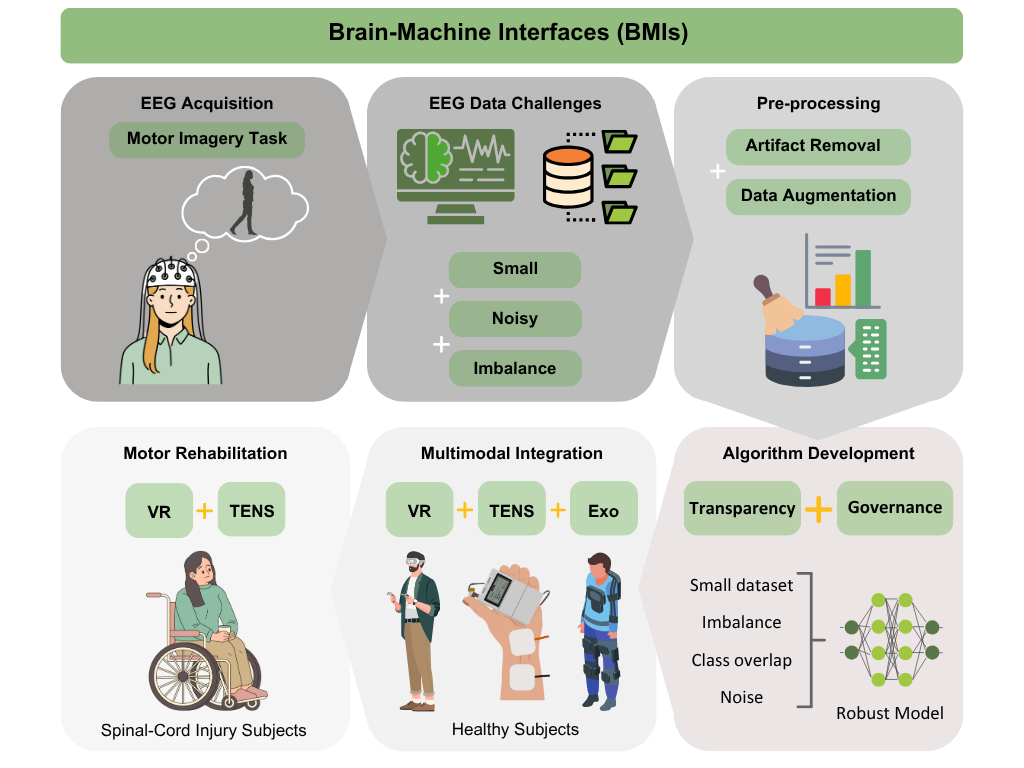
Restoring mobility in individuals with motor impairments is one of the most ambitious goals in neurorehabilitation. At the intersection of neuroscience, machine learning, and assistive robotics, we are developing Brain-Machine Interfaces (BMIs) that can decode motor intentions from brain signals (EEG), even when data is limited, noisy, or imbalanced.
Here’s what makes this research innovative:
🔍 Real-World Challenges
We’re working with real EEG data, which is notoriously difficult to collect and often noisy. But this is precisely what BMIs need to address in real-world applications.
🖥️ Multimodal Systems
Our BMI system integrates Virtual Reality (VR), transcutaneous stimulation, and exoskeletons to offer a comprehensive rehabilitation solution.
⚙️ Robust and Accurate Algorithms
We’re developing machine learning and deep learning algorithms that adapt and generalize across individuals and sessions, even when faced with small datasets.
💡 Rehabilitation at the Core
Ultimately, this research aims to help patients regain mobility through cutting-edge technology, advancing neurorehabilitation and improving quality of life.
By merging EEG signal processing, machine learning, and robotics, we’re paving the way for a future where brain signals can control external devices, revolutionizing motor rehabilitation.
Authored by: Júlia Ramos
In collaboration with: Susana Brás, Miguel Pais-Vieira, Andrew Stevenson
Supported by: IEETA, iBiMED, FCT
Share in: